Services
We are a computing laboratory providing you with cutting edge computational hardware and services to support the teaching, development, testing and production runs of various applications, including AI agents. To learn more about our mission and the services take a look at the recording from our latest HPC and RSE workshop. For computational resources supporting large-scale calculations of production-ready code please use IT4I or Metacentrum.
Our Research Software Engineering team is available for assistance with your codes and developments.
Most services can be accessed using your standard CAS university credentials. All users are required to follow the faculty and the university rules for usage of IT services.
- What you should expect from us: To maintain the clusters, the services, to communicate with you about major changes and outages and to respond to your requests and questions, to implement new features and changes per user requests.
- What we expect from you: Be familiar with the documentation for the services you wish to use to the extent that your technical abilities allow it. We expect you to communicate with us if something isn't clear, you don't like how the cluster is setup or something doesn't work for you. By complaining to us you help yourself and all other cluster users. We expect you to respect that the cluster is a shared resource and a shared responsibility.
1. High Performance Computing for Research
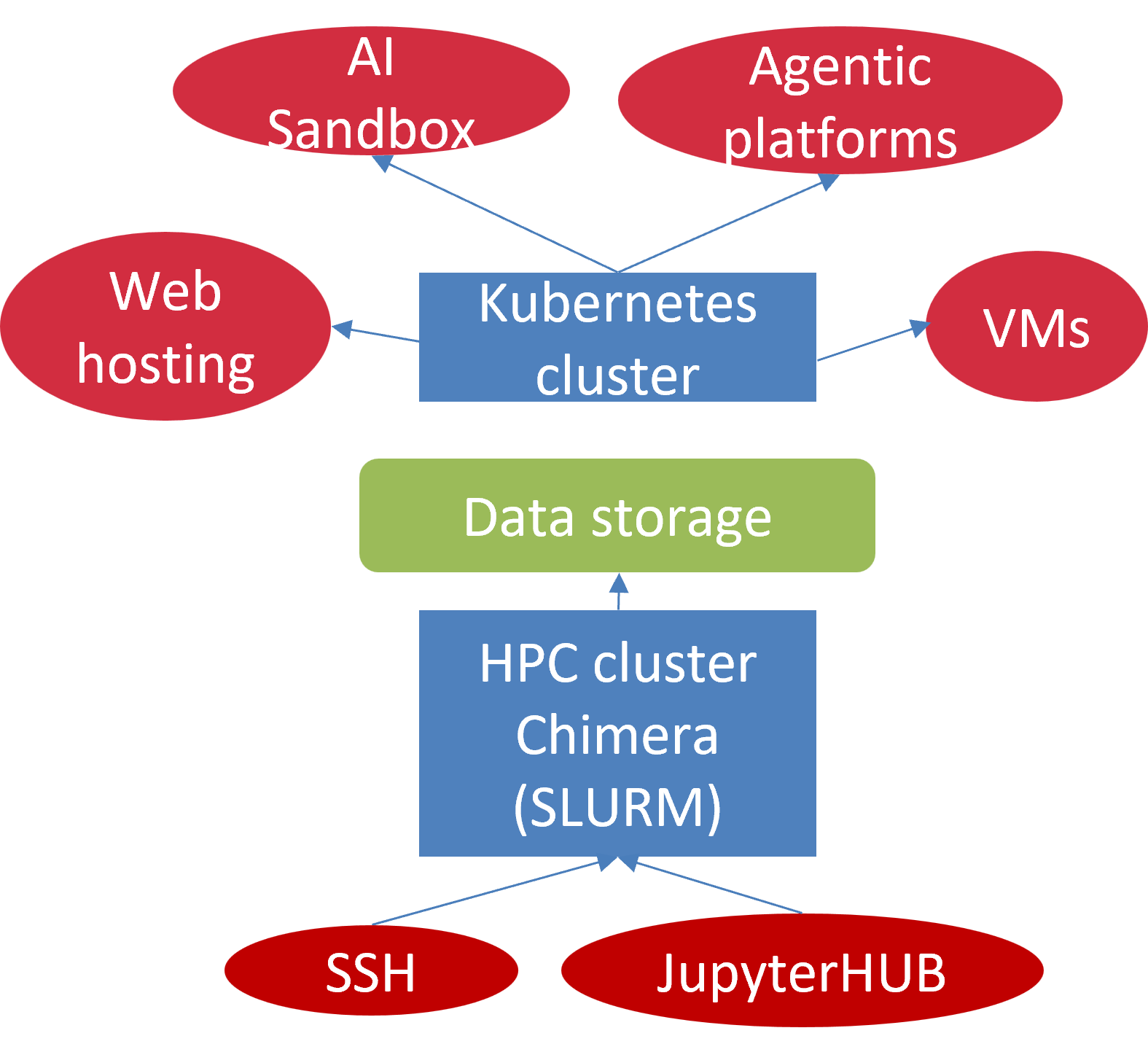
The cluster of the Faculty of Mathematics and Physics, is a virtually interconnected infrastructure comprising the Chimera cluster located in Troja and the Parlab cluster from Malá Strana. Users can access the cluster and run computational jobs across these resources using the SLURM resource manager either manually or using a natural language input (LLMs) in combination with our ChimeraMCP connector.
2. Cloud services
-
JupyterHUB: Connected with the Chimera cluster, the JupyterHUB environment runs in your browser and allows you to run various applications (Jupyter notebooks, R Studio, LangFlow, etc.) in a graphical environment. It allows you to access the command line too. First you choose the resources required for your work and the time you need them for. The graphical interface is then launched and you can work with any applications interactively within the fixed reserved resources. JupyterHUB is frequently employed for teaching.
-
Kubernetes: Running on a separate hardware the Kubernetes cluster provides access to a growing collection of web applications such as OpenWebUI, LangFlow, etc. It is intended as the primary interface for applications working with Large Language Models (LLMs). Simply connect directly to the service you wish to use, e.g. OpenWebUI. The computational resources of the cluster are dynamically allocated (shared) between all users of the cluster.
3. Gateway for Large Language Models
- LiteLLM: On request we can provide you with a personal API key to our LiteLLM service which will give you access to various providers of Large Language Models, including our local ones and high-end commercial providers. You can use this API key directly in any application requiring access to LLMs.
4. Agentic research
- Agentic platforms are of increasing importance across many fields of research. To help you use them we have implemented the ChimeraMCP connector and agentic SKILLs to help your agents make use of the Chimera cluster effectively. We are also deploying a range of agentic applications on our Kubernetes cluster, including Claude Science for biomedical research.
5. Teaching & Education
- Teaching: We encourage you to take advantage of our services for teaching and educative purposes. Nodes of the Chimera cluster can be reserved for your regular or one-time classes. On request, other services running on the Kubernetes cluster can be used for teaching too.
Services in a picture